
Weeks 1-12, 2026
The working over of Art and Mathematics in Krems, the Wachau and Borgo Sansepolcro continues at such a pace that I am unable to maintain the Reloading Humanism blog. Illustrating the progress that has been made, where a year ago I was unable to make either head nor tail of Sylvia Ronchey’s L’Enigma di Piero, I now find that I am informed enough to be able to work out what she is saying despite the fact that the book is in Italian and my Italian is rudimentary in the extreme. Happily, not only do I agree with everything that she says, but my insights support hers.
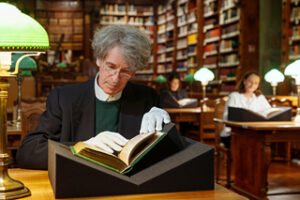
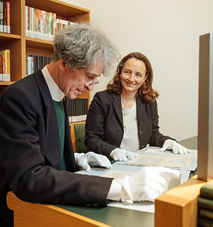
In the National Library in Vienna, I am a model for a series of publicity photos and pose in the room where I often consult manuscripts and the library’s older printed books (copyright: Österreichische Nationalbibliothk / Klaus Pichler).
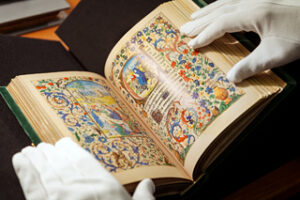
Above and below I am shown looking at a facsimile of Maria of Burgundy’s illuminated prayer book.
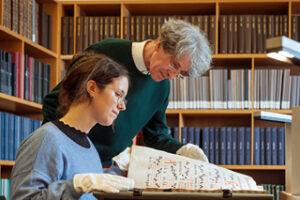
In the music collection, we examine a hymn book used by the choir of the Imperial Court Chapel. This dates from the reign of Emperor Friederich III, who in Art and Mathematics is an important background figure as it was at his court that Peuerbach and Bessarion met, with Bessarion commissioning from the renowned Austrian astronomer, an updated commentary on Ptolemy’s Almagest.
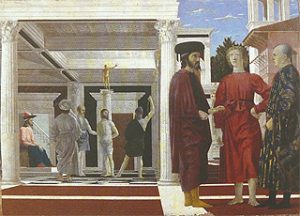
Although Peuerbach started work immediately, he died a few months later and the task was taken on by Regiomontanus, who was Peuerbach’s star pupil. Under Bessarion’s patronage, Regiomontanus learnt Greek, translated the Almagest and then went on to write a number of works that were immensely important for the further development of astronomy and mathematics. Friedrich III also initiated the Melk Reform, a process in which the lapsed monastic ideal was revived and monasteries reasserted the importance of learning, with this prompting them to confront and get to grips with the new view of the world that science was bringing into being. It was against this background, that a theological discussion known as The Controversy of the Doctrine of Learned Ignorance unfolded, with the monastery at Melk and the Charterhouse at Aggsbach both playing important roles. Via Cusanus and his realisation that pi is a transcendental number and not a conventional irrational, the new mathematical vision of God was communicated to Piero della Francesca when he and Cusanus were both in Rome in 1458/1459. This I argue, is discernible from Piero’s Flagellation, which Ronchey argues, was commissioned by Bessarion.
Meanwhile as a virtual visitor, in the Vatican Library in Rome, among the hundreds of books that have been made available online, I find a poem written by a visitor at the Court of Urbino in which a painting by Piero della Francesca serves as the departure point for an eulogy on the Duke of Urbino, Frederigo da Montefeltro, and on the God who endowed him with a soul. This is Codex Urb. Lat. 1193, https://digivatlib.it:
A painted Image by Piero della Francesca of Burgo Sansepolcro – An Address to the God of the Same
In the poem, the portrait addresses the viewer, pointing out that even the most famed artists of Antiquity would have longed to produce an image such as Piero has produced:
By a great and awe-inspiring hand I was made:
so renowned that Zeuxis would sore feign it as his own,
in marble Euphranor count it to his oeuvre,
whilst Pyrgoteles would have made a gem or bowl.
Not the work of Praxitiles or Lysippos,
nor Polycrates or Phidias’ skilled hand,
no, it was Piero who gave me flesh, nerves and bones,
whilst you Lord, enriched me with the depths of your soul.
Speaking I strive to defend that planted within
and so as a ruler and patron, praise God’s Glory.
Although now this portrait is no longer extent, two other images of Frederigo painted by Piero della Francesca have survived, including the double portrait showing him together with his wife, Battista Sforza, which has become iconic of the Renaissance.
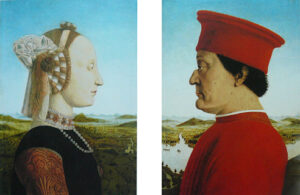
The work is a consolation piece commissioned so as to praise Battista following her tragic death at the age of 26. Despite Battista being married at the age of 14 to a man who was 14 older, the marriage was a happy one. At Frederigo’s court Battista studied philosophy and as Countess (for Frederigo had not yet been appointed Duke) flourished, managing her husband’s affairs when he was away on military campaigns. During their years together, the only thing that marred their happiness was the fact that Battista repeatedly boure daughters and Frederigo need a son if he was to have a direct heir. After eight daughters, the long awaited son arrived, only weakened by pregnancy, when Battista caught pneumonia some months later, she became terminally ill. Hurrying back from a campaign, Frederigo found his wife unable to speak and she died soon after. Devastated, Frederigo vowed never to marry again, gave up campaigning and as indicated by the red hat of scholarship, deoted himself to study.
Checking over the last chapter of my manuscript, I find that unplanned, but highly appropriate, the work ends with the words „out of itself“ – this being nothing other than the Reloading Humanism motto.

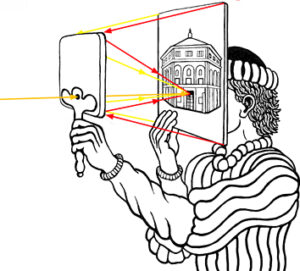
Yet this is not all and over the course of February, work has also proceeded apace on the missing diagrams and images so that, on the 19th March, the long awaited day arrives when I complete the last image. This is a drawing of how in around 1413, Fillipo Brunilleschi staged a demonstration that it was possible, via perspective, for artists to paint images of the world that indistinguishable from the same scene as reflected by a mirror. To this effect, standing at the entrance to the Cathedral of Santa Maria del Fiore, he painted an image of the Baptistry opposite. Then, where the central vanishing point was, he made hole. Holding a mirror out before him, in which there was likewise a hole, and with the painted image of the Baptistry facing the real Baptistry, he aligned the painting and the mirror so that through the two holes he could see the Baptistry doors. In this way what he had painted was perfectly aligned with the reality that he had depicted. As the presence and absence of the mirror made no difference to what was seen, what was painted was indistinguishable from what had been painted. To heighten the effect and to stop the weather spoiling the illusion, instead of painting the sky, Brunilleschi guilded the painting with silver, so that through the combination of painted image with a twice reflected sky, viewers were unable to tell the difference.
Week 13, 2026
In experiments conducted to ascertain whether people really do prefer the Golden Section over other proportions, although a significant amount of people do respond accordingly, there around two thirds of people who do not. Not surprisingly, this invites scepticism as to whether the ratio really does play a role in aesthetics. There is also the question of how precise is the ability of people to distinguish between two very similar proportions when for example, the rectangles that are typically used to embody the ratios are not next to each other and cannot be readily compared? Is there not a band of tolerance? Although common sense says that there must be, this is a weak weapon when it comes to countering scepticism and in any case is not scientific. Reluctant to invest time investigating statistical analysis techniques, I realise that the question is also one of information and the preservance of signals transmitted via a medium. Looking on the internet for something along these line I find an article that describes exatly what I am looking for: optimization-online.org. Thus as the week begins, I find myself incorporating the techniques into Art and Mathematics with the conjected band of tolerance underwritten by some hard-nosed maths. In the case of the rectangles used by Fechtner, where 35% of people preferred the rectangle with Golden Section proportions, 39% of people preferred either the sligtly smaller or the slightly larger rectangles that are only marginally different from the Golden Rectangle. Using information theory and statistcs, the article shows that both rectangles belong to the band of tolerance that is associated with the Golden Rectangle. In this way, preferance for the Golden Rectangle is raised from 35% to 75%.
During the week, I also finalise the „blub“ for the back cover of Art & Mathematics:
Making geometry and music central to his philosophy, Plato denied the ability of artists to depict the true nature of things. Countering this, Renaissance artists stressed the mathematical nature of perspective and the musical nature of proportion. Meanwhile anomalies in the calendar prompted astronomers to question the work of their predecessors and develop a new form of mathematics. Responding to this, Cusanus argued that God could be approached through geometry. In the Wachau this was challenged and a religious controversy ensued. Yet all the while, Piero della Francesco was using complex geometrical constructions as the basis of a new form of painting. Prompted by Cusanus, he combined all of these themes with a pressing political issue and painted The Flagellation. Using a hidden method of construction, in his Resurrection he then squared a circle. Twenty years later, in a mathematical treatise, he hinted at the geometrical key that he had used. In Krems this then provided the ground plan for a forgotten masterpiece of northern Renaissance art.
Week 14, 2026
In my reading I decide that it is time for Lesley Chamberlain’s The Philosophy Steamer, in which the story is told of how Lenin expelled Russia’s intelligensia so as to ensure that the strictly material form of communism that he envisaged would not become contaminated with rival views. This might seem a strange choice but in fact is as relevant as it is topical. For Chamberlain, the key message that Nikolai Berdyaev, repeated again and again, was that without a sense of the transcendeant, he did not see how humanity would be able to remain in touch with its greater aspirations towards spiritual freedom and moral self-determination (p. 20). A key aim of Bolshevism, Chamberlain says, was to destroy not only the Church as an automous instituition but also Christianity as a source of popular authority. Here a key objection was that religion sanctioned inwardness, with this allowing the individual freedom of thought. In the form of communisn that Lenin envisaged, a spiritual take on life was not permissible and thinking for oneself was undesirable. Accordingly, all who articulated such views were rounded up and put on two ships and deported. „Soviet totalitarism“, Chamberlain writes, meant nothing less than „denying individuals the possibility of a discrete innere life“ (p. 28). Today the trap of capitalism in it current form is that whilst freedom is promised, it is really something so abstract, that only the de-humanised entity known as homo oeconomicus can attain it and in practice, real humans (with inner lives and emotions) are left pitted against one another, to become slaves to an inhuman system of mutual and systematic exploitation. In this system, everything personal and relating to an inner realm is either negated or commercialised to become a pale and vapid echo of what it once was. Of this, the philosophy steamer described by Chamberlain and its cargo of exiled intellectuals is a premonition and a chilling metaphor for what capitalism has brought about by other means. Both capitalism and communism are ideas that, aiming at ideals, need to be filled out. The problem with both is that the take on them and the way that they have been interpretated, filled out and realised, has so far always been vehmently modernist, with not enough importance being attributed to the inner world of the self and its needs.
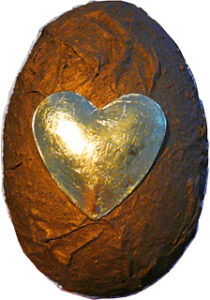
From the evening of Maundy Thursday until the evening mass of Easter Sunday, in Catholic countries the bells of churches go silent and only the quarter hours are marked. To call the faithful to prayer, cog rattles are used so that whilst the four days of Christ’s suffering and death are a time of limbo, there is nevertheless a sense of alarm and frenzied urgency in the air. This is the time when the whole world holds its breath to see whether the Saviour will be born again. In his De visione Dei, Cusanus advocates a withdrawal into darknes, that amid darkness a true, light might be discovered and allowed to shine and I see this as being the ultimate mystery that lies behind the Easter story of death and rebirth. Accordingly, as I do every year, I make a egg and leave it for a loved one to find on Easter Day.
Week 15, 2026
The formated manuscript of Art and Mathematics in Krems, the Wachau and Borgo Sansepolcro printed out, work begins on a final edit prior to proof-reading. Finding two passages which are too mathematical and interrupt the flow, I move them to the appendix. Elsewhere I expand a little and add an illustration.
Week 16, 2026
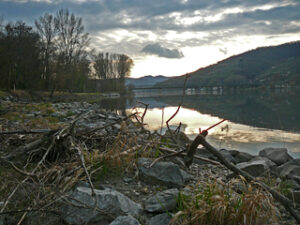
Walking along the banks of the Danube I find an old football and realise that, composed of 20 hexagons and 12 pentagons it is an example of an Archimedean semi-regular solid.
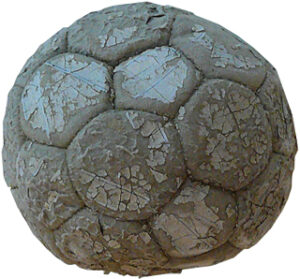
In geometry, where each of the five regular, so-called „Platonic Solids“, are formed from a single regular figure, the semi-regular solids are formed from two or three such figures. Discovered in Antiquity, the semi-regular solids were investigated and written about by Archimedes. By the Renaissance, Archimedes‘ work had become lost and all that remained was a list of their properties compiled by Pappus. Yet Pappus‘ work was limited to a single manuscript and so was as good as unread. Realising for himself that from the Platonic Solids other bodies could be generated by cutting corners off, Piero della Francesca worked out how to construct six semi-regular solids, including the truncated icosahedron.
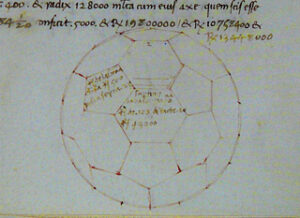
By the middle of the sixteenth century, Luci Pacioli, Albrecht Dürer and Danielle Barbaro had each worked out how another two solids were to be constructed, thus taking the total up to twelve. As they had no knowledge of there being thirteen lost solids, artists and mathematicians of the Renaissance were motivated not by a yearning to rediscover that which had become lost, but rather to discover how, from the Platonic Solids ever more complex forms might be arrived at with this being seen as the signature of world’s architecht and creator.
In 1588, a translation of Pappus‘ works was published in Latin including the list of the thirteen semi-regular solids discovered by Archimedes. In his Harmonice mundi of 1619 Johannes Kepler gave the solids the names that they have today and whilst aware of Pappus‘ list, appears also to have known the works, not only of Barbaro and Dürer but of an anonymous author who worked out how the thirteenth Archemedean sold was to be constructed. Evidence of this comes in the form of fourty wooden blocks used for printing. Only ever used for trial purposes these point to a lost and unpublished book and depict the planar nets that enable a wide selection of regular and semi-regular solids to be made. The blocks are preseved by the Albertina Museum in Vienna and a recently published article throws light on their history and the possible identity of the author and the subject matter of his lost work: veraviana/history-of-science/
During the nineteenth century, a thirteenth century prayerbook was identified as being a palimpsest, which is a manuscript where the original text and images have been washed and scraped away so that the parchment may be re-used. Dating from the tenth century, in its original form, the book was a product of the Macedonian Renaissance and featured a number of works of Greek geometry, including Archimedes‘ lost work on the thirteen solids. In the thirteen century, the text and drawings were scraped away and the volume was turned into a prayerbook. As the scratched away letters can be recognized, during the nineteenth century, the palimpsest was identified as containing lost works of Greek geometry and in 1915, the discovery was announced in an academic journal. During a tulmultuos period that followed the First World War, the monastery where the work was found was forced to evacuate its library and the manuscript went missing. For seventy years it was lost and only re-surfaced prior to being auctioned in the 1990ies. The manuscript it transpired, had been acquired by a businessman in Paris who had hoped to sell it privately. To raise the value, fake illuminations had been painted over some of the pages. Nevetheless, despite the „enhancement“, a private sale could not be arranged and the man’s daughter had no choice but to go to an auction house and accept that the matter would go public. This resulted in the monastery to whom the manuscript had originally belonged, contesting the legality of the ownership, with the charges being however overruled. At the ensuing auction, the work was purchased by an anoymous American buyer and deposited at the Walters Museum in Baltimore so that it could be studied and conserved. Using a variety of image analysing techniques, the whole of the original text has now been recovered and Archimedes‘ work on the thirteen semi-regular solids may again once be read. See: en.wikipedia.org and archimedespalimpsest.org.
Week 17
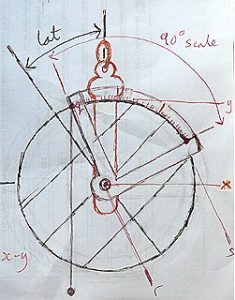
The week begins with my starting work on a replica of a universal astrolabe designed by Georg von Peuerbach, which despite its nme, is in fact a sun dial that can be set for any desired latitude. Here the original plans of the parts are to be found on the pages of Codex Yale 24, with my sketch of the assembled whole (which dates from week 35 of 2025) being:
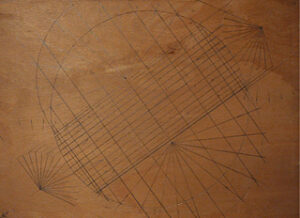
The first step is make the organum Ptolemei on which the scales of hours and days of the year are given.
The inner circle which encloses the organum Ptolemei is then cut out and, fitted with a sleeve from which it is supported and a moveable scale and an alidade with sighting vanes, is then theoretically, ready for use.
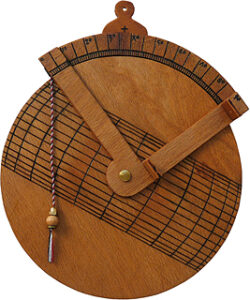
In practice however, the instrument requires a widget or screw system on the back so that, set to the latitude of observation, the plate may be secured to the sleeve whilst the height of the sun is being measured using the alidade. As Peuerbach gives detailed instructions on how the geometry of the instrument is to be utilised but nothing on the mechanical practicalities, the implication is that his real purpose is to show and bring to the fore, the sines and cosines that mathematically describe the position of the sun in the sky and which he can otherwise only refer to using long and cumbersome concaternations of words. The reason for this is that modern algebra was only just beginning to come into being and the use of graphs was not yet widespread.
Week 18
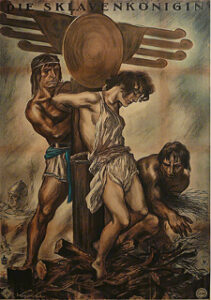
The week ends with a „Flower Moon“ and a screening of the „The Moon of Israel“. Where the former is the first full moom in May, the latter is a film by the Hungarian director who in America became Michael Curtis. While not his best film, it ingeniously weaves a love story into the Biblical story of the Israelites‘ escape from Egypt. Complete with special effects, in the film, with God’s help, Moses seperates the waters of the Red Sea and then releases the waters so as to engulf the Egyptian army that is in hot pursuit of him and his people. As announced by the poster for the film, the price for a successful escape is paid by the „Moon of Israel“, whom Egyptian priests abduct and are intent on burning.
Week 19
Although Art & Mathematics focuses on the Quattrocento, in other words the 1400’s and as such is complete, I realise that in order to conclude the various interwoven themes of the book, I must also explain how intellectually, the Renaissance came to an end. Here the moons of the previous week are prophetic and I realise that the end of Art & Mathematics is the story of how Galileo was able to diagnose what he saw through his telescope as being shadows cast by craters, vallies and mountains so that he could conclusively argue that the moon was a spherical body like Earth and was not a disc on which the naked eye could only make out diffuse and obscure shapes. Although at around the same time an Englishman, Thomas Harriot, also looked at the moon through a telescope, unlike Galileo, he was not trained in the geometry of projective systems and did not have active knowledge of how from shadows, the position of a light source could be deduced. As the telescopes that Galileo and Harriot were using only had a magnification of around 20 x, what they saw of the moon was still something that had to be interpretated. As someone knowledgeable in perspective, Galileo thus had a head start over Harrison, who only noted a „strange spottedness“ and was unable to diagnose what was causing the spots.
As the Milky Way is named after the Greek, Gala Xia, which means literally „Milky Street“, and as it is reasonable to assume that this is an Indo-European translation of an older Neolithic expression, it is possible that the English saying that the moon is made of cheese, is also Neolithic. This is because cheese-making was a Neolithic invention, with the round shape of the moon being self-explanitory, whilst its blotches may have been explained as mould. This in turn raises the question of whether the mould thus referred to, was blue or grey. Where the former is a speciality that is can be enhanced through storage in caves where the spores are naturally abundent, the latter is everywhere and is a bane to cheese-makers.
Week 20
In Bruck on the Mur, in Styria, I read Werner Bätzing’s Homo Destructor: A Man-Environment Story. Unfortunately only available in German, due to being interdisciplinary and holistic in ways that other books fail to achieve, Homco destructor is an important book. Equipped with a clearly thought out anthropological concept of what a human being is, the author is able to navigate his way through the epochs and ages of human history, identifying the changes that surrepticiously have resulted in our ceasing to be Homo sapiens – the knowing one, instead via Homo oeconomicus, becoming Homo vastratrix – the destroying one. A specialist on the environment of the Alps, Bätzing combines philosophy and anthropology, sociology and economics, history and evolution. Importantly in today’s world his book is not eurocentric and the holism he achieves is attained by first examing individually, the commerce, society and the ways that space and landscapes are used in each age under consideration. Only then are these three strands woven together to make a braid that points to the holistic whole that is ultimately being referred to. In this way, Bätzing avoids explaining an amalgan of complex processes in terms of a single principle. At the same time he is able to avoid falling into the trap of associatively picking and choosing themes and motifs that, although they point towards the totality of a whole, have not been systematically introduced and so represent a subjective choice that lacks objective authority. By naming and analysing the evils that have made us what we have become, Bätzing shows that the problems the world faces are cultural and that only by radically re-thinking who we are and what life is about, will we be able to overcome them.
Although a part of the natural world, due to our being mult-taskers capable of coping with a wide range of consitions and environments, by continually adapting to the conditions that we ourselves bring into being, humankind has become alienated itself from the basic realities of life and the fact that the things we need are not necessarily available in never-ending abundance. Only as hunter-gathers did our ancestors succeed in taking what they needed in ways were fully in tune with the environment in which they lived. Thereafter, gradually but nevertheless continually, ever increasing populations led to ever more being needed. For thousands of years this was achieved through specialisation, with increased efficency and increased productivity enabling more to be produced in ways that masked the continual taking from the natural world of ever and ever more. With the Enlightenment, the process of rationalisation became manifest, whilst the introduction of paper money enabled governments to print money that equated with the expected income from the next year’s taxes. In this way, money became equated with betting on the future and capitalism was born. With the advent of consumer societies in which agriculture and heavy industry have become minority sectors and the majority of people work in service industries, the only way that such a system can be maintaied is through the introduction and propagation of the notion of infinite growth. As on a planet of limited resources, this is impossible and through a lie that no one bothers to question, we all work flat-out to destroy that which nominally would preserve.
Getting to the underlying nub of the problem, Bätzing sees the great lie of the moden world as being held up and made atractive by four abstract constructs which apart from being abstractions of things in life, are at the same time abstracted away from the conditions of life as lived by normal people. This means that like paper money, whilst they demand belief in the here and now of the present, what they deliver is a promise of something that that lies in the future.
i) Homo oeconomicus. This is the notion that a human being is a completely free agent, miraculously disjoined not only from the constraints of life and work but also from family, friends and other groups to which all normally adjusted people invaribly belong. In the workplace, these include such institutions as trade unions and which accordingly contradict the notion of Homo oeconomicus.
ii) Electio operis. The idea that one has complete freedom of choice as regards work and career. This abstracts away from the fact that work is a means of ensuring that one gets what one needs in order to stay alive, replacing it with the idea that work is a form of self-development that enables one to become who it is that one is supposed to be. Here again this is contradicted by trade unions.
iii) Forum liberum. This is the belief that in a free market, good services and good products will inevitably win out and triumph over those that are less good. As Marx realisd, this is not the case and instead big companies invariably squeeze out medium-sized competitors, leaving only multi-nationals and small companies doing things that the multi-nationals are not interested in doing.
iv) Democratia. This is a belief in democracy and rests on the belief that all citizens eligiable to vote are equally capable of making informed decisions as to how a country is to be best run for the long term benefit of all. Although this is laudiable, social media and fake news have shown that the democratic ideal is fragile and rests on a number of assumptions which can be manipulated, with the multi-nationals of iii) above being among those who have the means and the interest in manipulating how people vote.
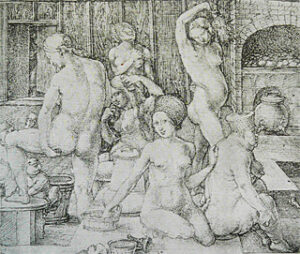
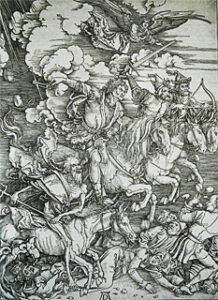
Bruck on the Mur is an appropriate place to read Bätzing’s book. The word „Bruck“ comes from the German word, Brücke, which means „bridge“. In Bruck there are a number of bridges, two which carry motorway traffic across the River Mur and acknowledging the fact that the town and its bridges are an important intesection a sculpture in the town proclaims: „INDUSTRY; TRADE, TRAFFIC“. Where goods were once transported along the region’s rivers, now motorways brashly barge their way along the winding vallies. Still to this day, Bruck is where steel is made. Where once large numbers of people were employed in steel-making, the rationalisation and down-sizing that has taken place has resulted in the town’s having seen better days and empty shops abound. Nevertheless among the general abandonment and post industrial tristesse, there are surprises which point to the service industries discussed in Bätzing’s book. Apart from a gourmet chochlate shop, there is a shop that stocks tinned sardines from countries all over Europe and North Africa. Meanwhile on the edge of the town, surrounded by motorways, a three-sided chapel stands alone and out of place. This is the Chapel of the Holy Spirit. Dating from 1422, the chapel was built to celebrate the town’s overcoming, War, Pestilence and Famine, which were seen as trio of evil that only the Holy Trinity could dispel. The chapel was restored by Philipp Harnoncourt, the founder and original director of the Baroque ensemble, Consensus Musicus. For Harnoncourt, the deadly plagues of today are the deliberate and on-going pollution of the ground on which we live, the water we drink and the air which we breathe. Living in a building that during the Renaissance was a bath-house, I am reminded of an engraving by Dürer and indeed in the breakfast room there is a copy:
Thus prompted, I think of Dürer’s The Four Horsemen of the Apocolypse, in which Death, armed with a trident and riding on an emaciated nag, joins Famine, Pestilence and War, in a last charge against humanity.
Week 21
As I struggle to finish Art and Mathematics in Krems, the Wachau and Borgo Sansepolcro, I realise that I must conclude with the founding of the first art academies and the philosophical switch that resulted in Renaissance Neo-Platonism being replaced by today’s scientific view of the world in which truth is arrived at by experimentation. In art academies, this switch-over resulted in perspective and anatomy continuing to be of central importance, whilst the rest of the Neo-Platonic package was by and large dispensed with. Reflecting this, when between 1872 and 1874, a new building for the Academy of Fine Arts in Vienna was built, there was a specially designed room where anatomy was taught with with a marble table where on only one occassion, a body was dissected: https://presseakbild.ac.at.
As the room was devoid of natural light it was unsuitable for drawing and so students continued (and to this day still do) to visit the Josephinum where there is a stunning collection of wax anatomical models. Dating from eighteenth century, these were made in Florence where Emperor saw the colection his brother, who was Grand Duke of Tuscany, had assembled and wanted the same thing for Austria: josephinum.ac.at. For the Florentine collection see: sma.unifi.it. Meanwhile for the full story of the first art academies see „Get back Loretta“ by the American art historian, Loretta Dimmick, who lives in Florence: getbackloretta.com.
Week 22
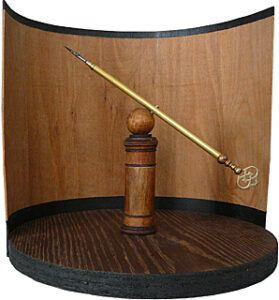
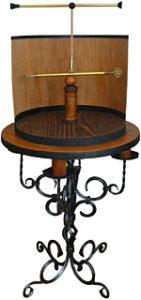
Back in Stein I find a physical embodiment of Piero della Francesca’s theoretical work on perspective that is not a drawing or painting but rather is a device. This is an instrument designed and made by Baldassare Lanci. Held by Museo Galileo in Florence, an animated video expains how it is to be used: catalogue.museogalileo.it. This leaves me with the task of fleshing out the museum’s flashy demonstration with an intellectually worked out proof. Happily I am able to invoke Theorems from Piero’s De prospectiva pingendi and then extrapolate to the general case by invoking a tract by Cusanus. This is the crucially important tract via which, in Art and Mathematics, I demonstrate that whilst Piero and Cusanus were both in Rome in 1458/1459, they met and talked on mathematics and the uses of mathematics in art.
Week 23
Making a copy of Lanci’s drawing device, I wrestle with the tricky problem of how to make a rotatable joint that enables both horizontal and vertical motion. Then there is the problem of how to make a telescopic arm onto which a stylus is mounted.
Week 24
Prompted by Lanci’s drawing device, I realise that I have not yet got to the bottom of Piero della Francesca’s De prospectiva pingendi. Yet I am not alone and to my surprise, none of the authors of the books and articles that constitue the specialist literature on the subject have got to the bottom of the matter either. Intuitively drawing a graph I make the necessary connection and realise that it is Cusanus‘ mathematical work supplies the missing insight, with this endorsing my theory that in 1458/1459, they met and talked of many things.
Week 25
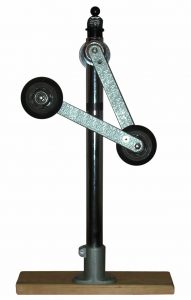
Prompted by Cusanus, my thoughts return to the series of reliefs begun two years ago and the missing mathematics that I know the series needs. With Cusanus‘ help I develop the model and then by invoking the work of Henri Poincarré on the Three Body Problem, prove that the model is an example of chaotic motion. This means that by combining an already made double pendulum with a already finished background, I can finish another relief and with renewed confidence can return to the series.
Week 26
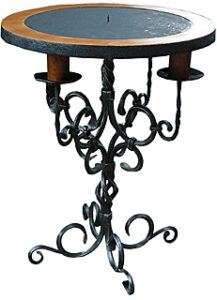
Getting to the bottom of Piero’s De prospectiva pingendi, I realise that the matter is, as discussed in Week 13 above, the issue of tolerance. This enables, through the admission a band of lassitude, greater accuracy to be aimed at and by acknowledging the limits that one is operating within, to also be attained. This shores up the latent Neo-Platonism of De prospectiva pingendi and endows the artist with the power to create. In my workshop this shoring-up is reflected by my completing the base of the Lanci drawing device, this being achieved by adapting a wrought-iron candlestick. This leaves the problem of how to affix the sighting tube to the stylus as the last remaining puzzle.
Week 27
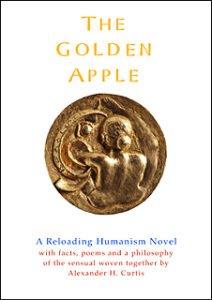
In the wake of a marketing initiative for Rediscovering History in Krems and the Wachau, I realise that the Krems and Wachau pages of the Reloading Humanism website need some fine-tuning. Replacing the uncompromisingly mathematical Laboratorium geometricum mellicensis with a much more digestible and appealing, In vino veritas page, I write The Museum Krems Guide to Wine-Growing and in the Museum take numerous pictures. As I make the changes, I see that the time is ripe for The Golden Apple to be published and that the new, In vino veritas page, is in need of just such an experimentally playful novel. The Golden Apple was conceived in 1995 when in the Kunsthistorischs Museum in Vienna, I saw a Roman plaque outlawing the Bacchic rites in Italy.
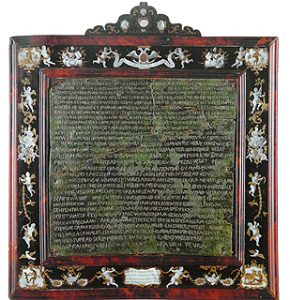
Looking at the plaque I felt within me, the stirrings of the wine god’s autobiography and three years later a first version was finished. Combining poetic scenes with passages of conventional fiction, reference, historical analyses, recipies and technical accounts of wine-growing the work was a meandering meditation on all that was Bacchic and Dionysian. Reworked ten years later and then again again twenty years later, the third version ultilises screen-writing techniques to introduce a tension and dynamic that was lacking in the previous versions. Despite solving the problems that had beset the work, due to the innane hysteria that has befallen publishing, I then sat on the work, waiting for a judicious sign or circumstance, not realing that it was up to me to bring that circumstance into being myself. Yet In vino veritas is just that and turning thoughts into deeds, I design a cover and resolve to publish the book just as soon as I can.
Week 28
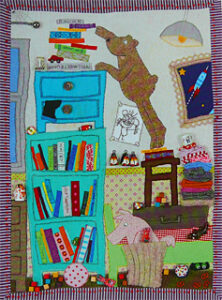
In Horn, I visit a textile market. Held every two years, this is refreshingly high quality event that feaures all manner of genuinely innovative and appealing clothes and textile-based products.Given the focus at Reloading Humanism on Gravettian Venus figurines, Isabella Scherabon’s felt copies of prehistoric Venus figurines are of particular interest: isabellascherabon.at.
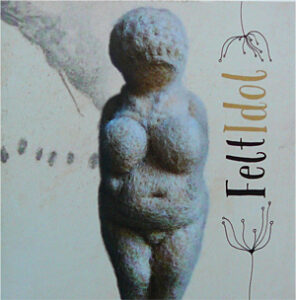
Giving a new slant to book illustation are Scherabon’s sewn together collages of textile: isabellascherabon.at. Also at the market and exhibiting sew together illustrations is Ruth Feile: riederbuch.de.
Week 29
In his The Nutmeg’s Curse: Parables for a Planet in Crisis, Amitav Ghosh weaves together a series of parables that show how the world’s current crises derive from the discovery of the New World by the West and the trade in commodities such as spices, tea, sugar, opium and oil. Giving voice to the basic tenet of Reloading Humanism Ghosh argues that ultimately our problems derive from a solely material view of the world, which results in it being seen as a resource that is to be exploited as if there were no limits and no further consequences. In one parable he begins by observing that although literary fiction is ideally suited to thematising the issues surrounding global warming, defaunation and the all-too real threats of a collapse of civilisation, authors shy away from it completely. Completely unrelated and without making any claims to literature, the specialist on insects, Dave Goulson, reverts to just such a strategy to show the realities of a world in which civilisation has collapsed due to the dissappearance of insects and the resulting failures of harvests.
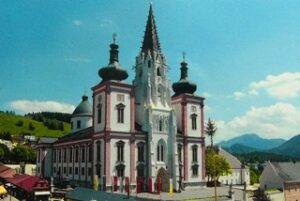
Appropriately I finish reading Goulson’s Silent Earth: Averting the Insect Apocalypse, in Mariazell. Tucked away in the heart of wooded hills that are the foothills of the Alps, in Mariazell there are noticiably more insects than in Krems. Articulating a different and yet related message, on the return journey, I notice the ever increasing dryness of the landscape as the small guage railway train weaves its way through the woods and down towards the flatter ground that surrounds Krems. In Krems, wine-growers are already beginning to experiment with red grapes as soon enough the day will come when it will be too hot for the grapes from which white wine is made. Echoing Ghosh’s observation with respect to literary fiction, everywhere people talk of climate change as it is something that we must adapt to, instead of something that can and must be stopped as otherwise civilisation will collapse, probably, as Goulson predicts, through the disappearance of insects and their ceasing to pollinate the plants on which our survival depends.
Week 30
Back in Krems I finally get around to making the sighting vane of Lanci’s drawing device and then get down to the real business of finishing Art and Mathematics in Krems, the Wachau and Borgo Sansepolcro.
Week 31
Prompted by my journey to Mariazell and the theme of pilgrimage, I make Saint James the Elder, who is the patron saint of pilgrims and pilgrimage, the patron of the Reloading Humanism Books and Music page.
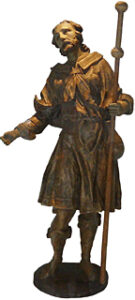
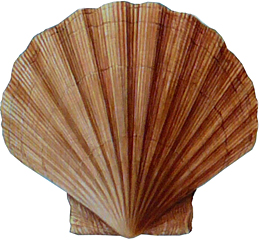
Opening a book initiates a journey of discovery which can be just as replete with pitfalls and dangers as a journey in the real world. At Reloading Humanism, the Museum Krems image of the saint promises to protect readers from false logic and from honeyied words that in reality are laced with poison. Where a pilgrim makes undertakes an outer journey in order to attain an inner goal, a reader embarks on an inner journies that may have either inner or outer goals – or a combination of both. Thus both pilgrims and readers are concerned with is concerned with inner-standing, outer-standing and understanding. This I realise, forms a new form of trinity, a trinity that if we are to survive, must be understood in all of its three facets: the self, the world around us and of which we are a part and the balance that we must find and continually cultivate between the two and which so forms a third component. In this way, the scallop shell that is the emblem of Saint James and of all pilgrims, becomes a fan behind which there is hidden pearl.
Weeks 32-36
Having identified Saint James the Great as the Reloading Humanism patron of books and reading, the ensuing weeks become a tempestous journey in which the history of art history is mapped out and in the form of the painter, Nicholas Poussin and the philosopher, Leibnitz, the essence of the Baroque is identified. As through ill-conceived analyses and a complete mis-understanding of what the Baroque was about, Poussin’s Et in arcadia ego regularly features in bizzare conspiracy theories and in the wild claims of pseudohistory, as the book’s penultimate chapter, an analysis of two of Poussin’s works is instructive and illustrates a number of things and proves the all imporatnt final point.
One of Poussin’s finest works is A Dance to the Music of Time, which is held by the Wallace Collection in London: wallacecollection.org. Whilst the seasons dance to the music of time played by Chronos on a lyre, a cherub watches the grains of time as they pass through the eye of an hour glass, whilst another blows ephemeral bubbles into the air with a straw. Yet the figures of the seasons are also seen as standing for poverty, labour, riches and pleasure, with Poussin himself not necessarily advocating a single, rigid interpretation. Above the dancing goddesses, Aurora, the goddess of the dawn, flies through the air, scattering the first glimmering rays of light whilst behind her, Apollo stands in his chariot holding a huge ring that represents the Zodiac that contains the sun as it moves throuh the sky. As the sun is guided by the ring of the Zodiac, Apollo has no need to steer the horses that pull the chariot of the sun, and the horses are goaded by the whip of an assistant who rides on the back of one of them. Behind Apollo, the early hours of the day have assembled and joyously dance through the fresh morning air. Looking both foreward and backwards, the god of wine, Dionysus, is also present in the form of a stele.
In Et in acardia ego, Poussin looks behind the dancing seasons and the light cast by the dawn of a new day, and shows a group Arcadian of shepherds who have gathered around the tomb of someone who is evidently long dead and long forgotten: collections.louvre.fr. Examining the inscription written on the side of the tomb, instead of a name and testimonies of great deeds, they read the words that give the picture its title: et in arcadia ego. Here the verb sum, that belongs to the pronoun ego, has been omitted whilst the word et, hints at an additional nuance that in English must be added. Thus the full meaning is; „And I too dwell in Arcadia“ and refers to the omnipresence of death. The point is that the shepherds are not startled or perturbed by this message but, knowing that all things come to an end, acccept it as an inevitable consequence of life, living and being alive.
For British people, there is an aditional layer of meaning, for the great expert on Poussin was the one time Sir Anthony Blunt, Keeper of the Queen’s Pictures and the fourth man in the spy-ring known as the Cambridge Five. Behind a glittering career, there was thus a trail of dark secrets and during the war Blunt gave highly confidential information to the Russians and in doing so endangered the secrecy of operations at Bletchley Park. In The Master of Lies by Piers Blofeld, it has been suggested that towards the end of the war Blunt leaked information to the Germans in order to allow Stalin time to capture Berlin before the Allies: observer.co.uk. Far from being the most benign of the five, Blofeld sees him as the most deadly. As he was so prominent and close to the Palace, after admitting to spying for the Russians, Blunt was granted immunity that lasted up until 1979. Questioned in the House of Commons by two opposition MP’s, Margret Thather saw no reason for covering up the staid caution and fetid complaincy of her predecessors and named Blunt as the fourth man. As at the tender age of 19, I stuggled unsuccessfully with Blunt’s book on Renaissance art theory, ordering a copy of the book, I am curious as to what, fourty years down the line, I shall make of it.