

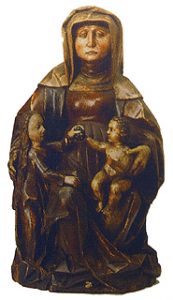
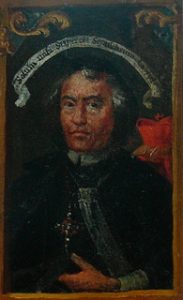
„Whoever you are and where ever you come from, Greetings! I’m Saint Anna and as you can see, I’m perturbed. Below me, my daughter Mary is handing Jesus, a bunch of grapes. These grapes stand for the torment and suffering the Passion that is to come. After being tortured, my grandson will then hang on a cross for three days until he dies of exhaustion. Somehow Mary and Jesus understand that this terrible fate is necessary and that it is all part of a part a divine plan but I don’t understand and I’m perturbed. Why must my grandson die? Why must he be so horribly tortured and humiliated? Amalthea, whom you met above, gave me some material but I still don’t understand. Perhaps you can help? Then you could come and visit me in Museum Krems and explain!
Death and Ressurrection
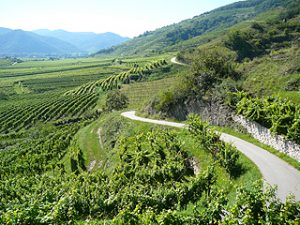
Vineyards on the way from Stein to Dürnstein
Wine-making can be dated back to the Neolithic. This is a period that began some nine thousand years ago. With the Neolithic, the semi-nomadic hunter-gather groups of the Ice Age became settled. Living in small communities people supported themselves through farming. This brought a new world-view into being in which the world was seen as the embodiment of of a goddess who lay behind and embodied all things. Multi-faceted and ever-changing, in human form the great goddess was maiden, mature woman and old hag. As a maiden she represented spring, as a mature woman, the bounty of summer, whilst as an old woman, she represented autumn. During the winter she completely withdrew and there was only a cold, desolate landscape and desiccation. Due to this fluctuating pattern, the goddess was associated with the moon. Where the first crescent was analogous to spring, the full moon was seen as being analogous to summer, the second crescent to autumn, whilst the new moon, which is never seen, represented winter and the period of withdrawal and hidden regeneration.
That all things were seen was emerging from the goddess is shown by images which show the goddess as a toad. This draws on the similarity between the toad’s natural posture and a woman giving birth in a crouched position. From the Neolithic, this tradition continued on into the Bronze and Iron Ages. An example from Lower Austria gives the form of a toad in three-dimensions. Modeled in clay, when turned over, on the underside there is a low relief depiction of a woman who has just to given birth.
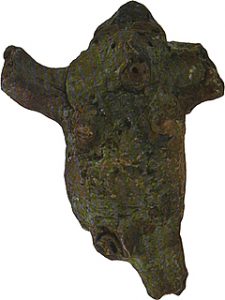
The Lady Toad of Maissau 1,100 BC, Höbarth Collection, Horn
In Austria, the goddess in her youthful aspect is shown by the Sala Women or Saligians. Again referring to newness, the expression means, the glowing, or shinning ones. In later cultures, the Saligans are Wild Women, as they shun the benefits of civilization. In the woods, they protect wild animals and punish hunters who shoot more than necessary. Sleeping in caves and rocky crevices, they live by rivers and in woods. When they tire of sleeping on hard surfaces, they enter a human dwelling and sleep on a free bed. As a payment, they leave a lock of hair which can be spun into thread for ever. From high places, they sometimes descend and help farmers. Echoing the three-fold nature the goddess from which they derive, the Saligians are thought of as appearing in three’s.
During the spring the goddess had as a consort, a handsome youth. Spring is a time when everything in nature is new and pristine. When this phase passes, spring must make way for the ripening bounty of summer. Thus in European mythology, numerous myths tell of a goddess and a mortal lover, who dies in the prime of youth. As today, the arrival of spring was celebrated at Easter. Then at the beginning of May, spring was celebrated again, only this time it was so as to bid him farewell. In Austria, May Day is marked through the erecting of huge poles in the squares of towns and villages. The poles are the trunks of fully grown pine trees. Stripped of their branches and bark, they are topped by a small Christmas tree. Around the pole, May pole dances are performed. Competitions are also held in which young men climb up the pole.
As the moon’s crescents resembled the horns of the bull and as, during the Neolithic and the summer months were characterized by the constellation of Taurus being prominently visible in the sky, the bull was associated with the growing corn and the summer harvest. Following the death of spring, the bull became the male counterpart to the benevolent bounty of the goddess in her summer aspect.
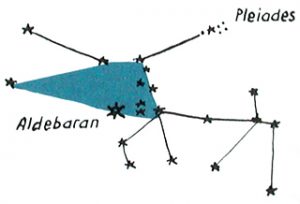
The constellation of Taurus, from The Stars, a new way to see them, H. A. Rey, Boston, 1952
In Austria, a figure known as the Corn Mother is a vestige of the goddess of the Neolithic as a manifestation of the ripening corn and is an old woman with fiery fingers and breasts that have iron spikes on them. For the farmer, it was essential to leave a last ear of corn standing for her in the field. Another form of the goddess in her mature incarnation is Frau Holle, who is an old woman with bad teeth. Known as Hulda or „she who should be honoured“, in Austria, she is also known as Frau Percht. Apart from the corn, Frau Percht is also associated with fertility, rebirth and metamorphosis in general. When she shakes her bed, feathers escape. These form clouds that dictate the weather. As the clouds were thought of as being spun, Frau Percht is the goddess of spinning and weaving. She supports those who are industrious and punishes those who are lazy. Frau Percht has a variety of appearances. She can appear as an enormous woman with flaxen hair and a white dress. Alternatively she appears as a withered old woman with an iron nose.
At the beginning of the harvest season, the constellation of Taurus would sink below the horizon and bulls were sacrificed. Thus after the summer harvest, all that remained of the goddess‘ consort were the later ripening fruits of autumn. These included the grapes of the once so vigorous vine. Yet when the grapes are pressed, they immediately start to ferment. Despite being battered and squashed, something in the brew is alive. Then when the juice is drunk, an alien power rises to one’s head. This was seen as a manifestation of the god. Although dead, his spirit was thought of as living on in the wine that had been made from the fruit of his body. Underlining this, wine was kept in skins made from the hides of sacrificed bulls. In this, once again transposed form, the goddess‘ consort was seen as the Green Man and was depicted as an empty mask entwined with vines. Although his body had been crushed and beaten to a pulp, the goddess‘ consort was thought of as living on it the intoxicating effects of the wine that was made from the fruit of his body.
For the Ancient Greeks there was no doubt that the intoxicating power of wine was a direct manifestation of the god of the vine. This was Dionysus, whose name means, a burst of light. Dionysus‘ mother was Semele, whose name means, earth. The two together thus refer to the fact that the Earth only becomes fruitful when warmed by the light of the sun. Thus both through his attributes, and via his name, Dionysus is a form of Green Man who once embodied the cycle of the seasons. Meanwhile Dionysus‘ father was the sky-god Zeus, who when on Earth, frequently appeared as a bull.
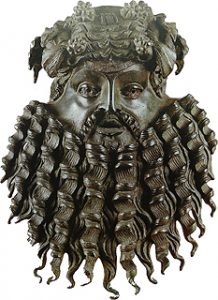
A mask depicting Dionysus. The mask was originally part of a handle for a large vessel, probably a situla in which wine was mixed. Roman, 1st century AD. Collection of Greek and Roman Antiquities, Kunsthistorisches Museum Vienna
For nine months of the year, the temple at Delphi was sacred to Apollo. Apollo was the god of prophecy and like Dionysus, was associated with light. As the two were half-brothers, from December to February, the temple at Delphi was sacred to Dionysus. Every second year, Athenian women were allowed to leave the confinement of their homes and go to Delphi. This took place in February, with the explicit purpose of honoring Dionysus.
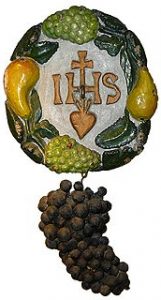
In Christianity, the letters IHS stand for Iesus homminum salvator, „Jesus Humankind’s Saviour“ and were part of the insignia of the Wine Growers‘ Guild of Krems and Stein.
Insignia of the Krems and Stein Wine-Growers‘ Guild, 1739, Museum Krems
Originally however, the letters stood for: In hic sallus or In hic signo, both of which mean „in this sign“ and the letters were used by the followers of Dionysus. Here the sign referred to was the staff borne by the god and his followers. This consisted of a long stalk of fennel, topped by a large pine cone. The significance of the staff is that stalks of fennel were used by Greek apothecaries for storing drugs and when it came to intoxicants and hallucinogens, and being possessed by their god, the women going to Delphi saw no need to stop at wine. Winter is the mushroom season in Greece. Wandering over the slopes of Mount Parnassus, they found Amanita Muscaria. Eating the red and white mushroom the women had powerful altered states experiences. Calling themselves maenads, they would run wildly over the slopes with their heads thrown back. Apart from hallucinations and senseless abandonment, they experienced upsurges in erotic energy and acquired remarkable strength.
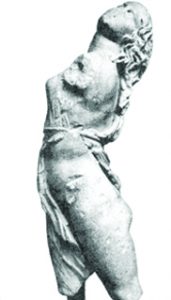
Maenad, 4th C. BC, Collection of Sculptures, Staatliche Kunstsammlungen Dresden
Both written accounts and depictions on pottery show that the women would not balk at handling snakes and fire. They would also tear wild animals to pieces and eat the raw flesh. For a few hours they would rampage over the slopes of Mount Parnassus, possessed by their god. After the wild abandon, they would be found lying exhausted among the snow. Needless to say, the women observed a code of secrecy concerning what they did. Yet to prevent them from dying from hypothermia, they had to be rescued. An eye-witness account says that they would be found lying on the ground, their clothes frozen as stiff as boards. The Bacchic rites provide examples of extreme case of a deity taking possession of those who believe in him and by the time of Euripides wrote the Bacchae, everyone knew, or thought they knew, what was being referred to.
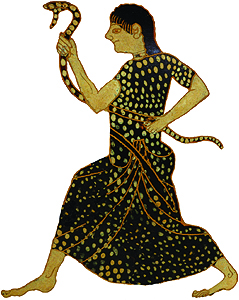
Maenad with a snake, detail from a black-figured hydria, the „Eagle Painter“, East Greek, ca 520 BC, Collection of Greek and Roman Antiquities, Kunsthistorisches Museum Vienna
From Greece, the Bacchic cult spread to Italy. The rites were held in secret and often led to excesses. Leaking out, this prompted a series of politically motivated scandals. Political intrigues then led to adherents of the cult being accused of conspiring against the state. After a scandal in Campagnia, the cult and its rites were banned in 186 BC. To this effect the Senate issued a decree. This was publicised through the displaying of bronze plaques in prominent public places. In 1640, one such plaque was found in Calabria. In 1727, it was framed and presented to Emperor Charles VI of Austria.
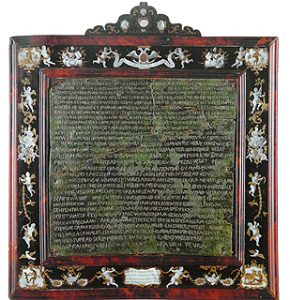
Plaque announcing Senatus Consultum de Bacchanalibus, Roman Republic, 186 BC, Collection of Greek and Roman Antiquities, Kunsthistorisches Museum Vienna
In the rites of Dionysus, one has the beginnings of the Christian sacraments and in the figures of both Dionysus and the Green Man, the vine is a personification of a figure who is destined die. Conquering death however, both figures rise again. It was therefore easy for Christian missionaries to argue that Christ was a new form of this older concept and missionaries and priests were allowed to hold Christian services at pagan temples. This they did with the idea of subverting the old religion, subtly steering it towards Christianity. The problem was that the old ways were not so easily eradicated. For hundreds of years, the two traditions existed side by side and in varying forms of fusion. Over time, this however suited not only local populations but also local priests.
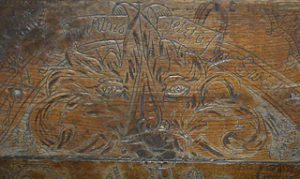
The Green Man as a vine leaf, detail from the engraved table top of a table from a wine-grower’s cellar, J. Lischka, 1920, Museum Krems. The moto above reads: „God is with us now and forever“
Reflecting the fusion of the old religion with the new, in churches throughout Europe, Green Men and other clearly non-Christian motifs also abound. This is not only true of early Romanesque churches but also of much later Medieval churches. Examples may even be found that date from the sixteenth century. A Romanesque example is on display in the cellars of Museum Krems. This shows the goddess of the Neolithic as a harpy in her death aspect.
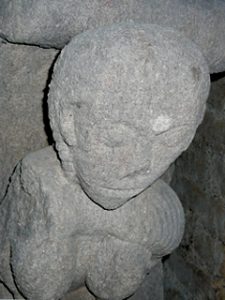
Harpy, Early Christian Age, Museum Krems
Where the great goddess incorporates within herself, the principles of both life and death, along with the ability to witdraw and regenerate herself out of darkness, stillness and nothing, her consort does not have this ability and so at the end of each season must die in order that through the goddess‘ regenerative power, he may be born again. Thus at the onset of winter, the goddess must retreat and withdraw into herself. To this effect in Austria, still to this day at the beginning of December, young men dressed in fur and wearing grizzly masks, run through the streets ringing bells and shaking chains. Traditionally they would whip women and girls they saw on the streets but this aspect of the custom has since been modified. The whipping was to prompt the goddess in each woman into withdrawing from the world and retreating into the stillness from whence she could regenerate herself.
In Christianity, although Jesus takes on the role of the god who must die so that the cycle of the seasons may start again, the message is changed and he dies for us. This is so that by shouldering the burden of our sin, if we believe in him, we might be saved from Hell and damnation through his rising again. Here an important part of Christian thinking is the drawing of analogies between the Old Testament and the New Testament. The Old Testament is thus seen as anticipating and preparing the way for events described in the New Testament. For the Old Testament references to wine see the article, Wine is Everything given below. In The Bible, the vine is a symbol for the House of Israel. This was the tribe to which Jesus belonged. In the New Testament, Christ says that he is the true vine and that God the Father, is the wine-grower. At the Last Supper, Christ exhorted his disciples to break bread and drink wine in remembrance of him. This is because he says, the bread is his body, the wine is his blood.
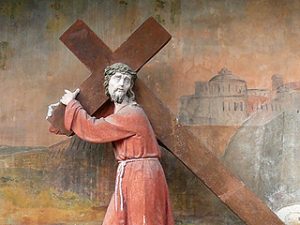
Christ carry the Cross, Stations of the Cross, Piarist Church, anonymous, 1658, Krems
As the new Green Man, Christ is the vine and so is associated with wine-making. Once picked, the grapes were placed in tall, narrow containers where they were bashed with thick poles. Then they were shoveled into a barrel. This was mounted on a cart so that the must could be carried down for a second, more thorough pressing. The reason for the initial battering was to save space. The battering and the journey in the cart were however also seen as being analogous to the torture and mockery that Christ went thorough prior to crucifixion.
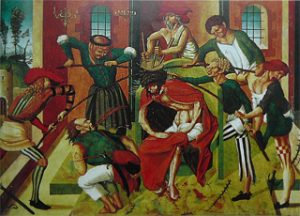
The Flagellation of Christ from the Aggsbach Altarpiece, Jörg Breu the Elder, 1501. The altarpiece was painted for the Charthouse at Aggsbach. This was dissolved in 1782 and the altarpiece is now in the Augustine Monastery at Herzogenburg
Thereafter, where the pressing of the grapes was the crucifixion, whilst the storing of wine in a cellar, was his Christ’s burial. During the Middle Ages, these parallels were seen as underlining to the notion of Christ as „the Man of Sorrows“. This made human beings mean, wretched sinners. Not only did God have to sacrifice his only son. The son had to undergo a program of mockery, torture and humiliation as well. Simply by virtue of being human, human beings were inherently wretched and sinful. Exemplifying this conception, a half-size crucifix in Museum Krems shows Christ hanging from the cross. Emaciated and exhausted, from the Saviour’s wounds, blood flows in hyper-real, three dimensional forms.
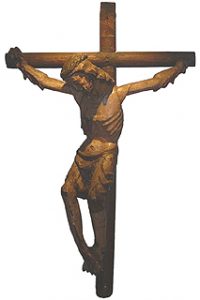
Crucifix, mid 14th century, Museum Krems
With the Renaissance however, the ways in which past events were seen as prefiguring New Testament events were extended. Via the equation that linked Christ with light, Jesus was seen as being prefigured by the half-brothers, Apollo and Dionysus. Meanwhile, God the Father was seen as being anticipated by the fatherly figure of Zeus. In this way, scholars and theologians lessened the emphasis on sin that had characterized the Middle Ages. No loner inherently wicked, a new view of humanity was ushered in. Reaching up towards the light, people were accorded the ability to do good and to perform noble deeds. This can be seen when two Renaissance sculptures in Museum Krems are compared with the crucifixion image already encountered. These show Christ very much alive, standing on his own two feet and showing his wounds. Though the wounds are clearly depicted, the poses show no signs of pain or suffering. In the first example, the message is: It was for you that I allowed them to do this to me. Look, believe and I shall absolve you from sin.
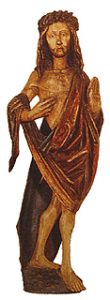
Christ Arisen, anonymous, around 1470, Museum Krems
Where the first figure of Christ Arisen is addressing us, the second is caught in an act remembering the torment and seems to be saying, Yes, it was out of love for you that I did this.
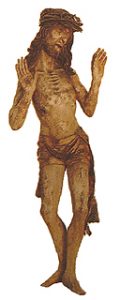
Christ Arisen, anonymous, around 1480, Museum Krems
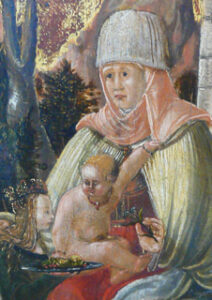
Here’s a painting of me that you can also see in Museum Krems. I’m still trying to understand all the strange things that Amaltheia told me about. But perhaps its time for a break from books, wise words and my worries! Now that you’ve heard all manner of things about wine, why not find out how its made!
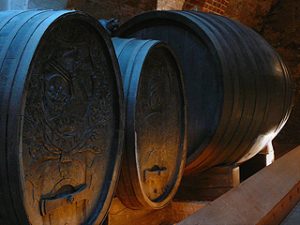
The Museum Krems Guide to Wine-Making
Due to the fact that wine was essential to the practising of the Christian faith, wherever early Christian Saints and holy men went, they introduced viticulture. As the monasteries in the Wachau were endowed with more land than the monks themselves could farm, significant tracts of land were leased to tenant farmers who instead of paying rent, paid a tithe of what they produced. This enabled the monasteries to concentrate on wine-making so that over time, Medieval monks acquired considerable expertise in all aspects of wine-growing and wine-making, step by step establishing the principles used by wine-growers today.
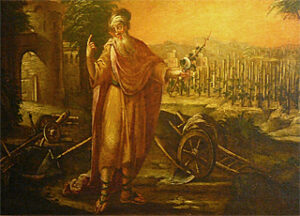
A detail from the painting Noah in a Vineyard, depicting the Patriarch as a wine-grower, anonymous, 1740
During the Middle Ages, 75% of people living in the vicinity of Krems earned their living from wine-making and the valley’s monasteries were exporting significant quantities of wine upstream. Wine from Krems was praised as “the renown and ornament of a table”. To ensure that quality was maintained, local representatives were appointed whose job it was to oversee all aspects of the wine-making process. Little is known of what grapes were used except for a mention in 1301, that Riesling grapes were used in the Wachau. In around 1400, it is also recorded that in Dürnstein, Muskateller grapes were grown. As the practice of training vines to grow horizontally along wires had not been invented, vines grew up and around poles that were inserted into the ground with paintings in Museum Krems showing vineyards planted up in this way.
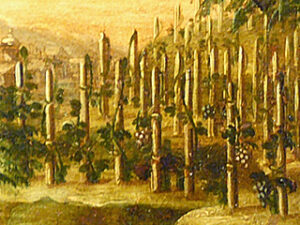
A detail from the painting Christ and the Apostles in a Vineyard, anonymous, 1740
For thousands of years this was how grapes were grown. The method of training vines to grow horizontally along wires strung between poles was not developed until the 1920’ies by Lenz Moser, who lived in Rohendorf near Krems. Over the course of a few decades the so-called “high culture” revolutionized wine-growing.
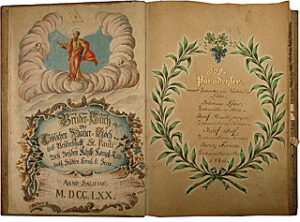
The Book of the Members of the Krems and Stein Wine-Growers‘ Guild, also known as the „Brotherhood of Saint Paul“ with Saint Paul depicted on the inner cover
For wine-growers, it was advantageous to form groups in which needs and resources were pooled and the first mention of a group of lay wine-growers with a shared set of interests dates from 1112 and records the concerns of a co-operative in Krems-Weinzierl. As the grapes ripened towards the end of August, the vineyards would be closed off to public access and were protected by guards, who were called hüter and whose job it was to ensure that the grapes were not unlawfully picked. In this connection, the document concerning the co-operative at Krems-Weinzierl, notes that the association chose its own guardians.
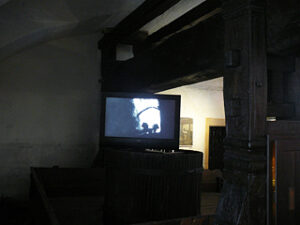
The film „Wine-Growing under a Guardian Star“
From Saint Laurence’s Day onwards, the wine-gardens were closed and remained so until the Feast of St. Martin in November. A highly informative film that may be seen in Museum Krems is, Weinbau untern Hüterstern, or „Wine-Growing under a Guardian Star“ (approximately 20′) which was filmed in Dürnstein in 1943. As shown in the film, during the period of closure, the guardians lived in the vineyards in huts which still to this day dot the landscape.
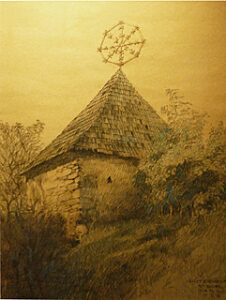
A drawing of a guardian’s hut
To show that the vineyards were closed, long poles topped by stars were erected and adorned with bunches of thistles. The first mention of such a pole being erected in the Wachau dates from 1394. The stars recall the wandering star that the three wise men followed and which stood still over Bethlehem as an announcement of Christ’s birth. Made of strips of wood, these Hütersterne are composed of dozens of Saint Andrew’s crosses arranged either radially or in concentric rings.
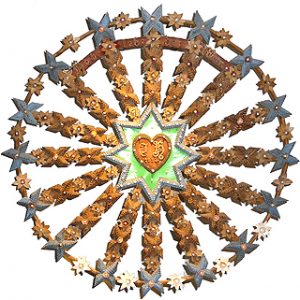
A Hüterstern or guardian’s star, 1913
Single Saint Andrew’s crosses were also attached to shorter poles that, hammered into the ground gave more exact indications as to which areas were closed off. Still to this day the period of closure is symbolically marked by a ceremony in which members of the Krems and Stein Wine-growers’ Guild present oversize keys to a regional official. To announce their presence and to communicate with one another, the hüter would blow horns.
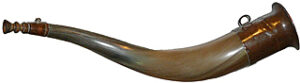
A guardian’s horn
To scare off birds, whips were used, whilst to announce the harvest, blank shots were fired from flintlock pistols. Further underlining their function as guardians the hüter also had swords.
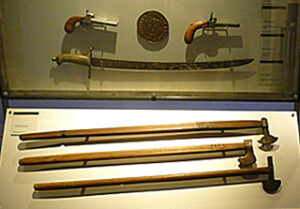
The pistols, swords and axes used by Hüter
Picked by hand, the grapes were gathered together in büten which once full were carried to where a cart was waiting.
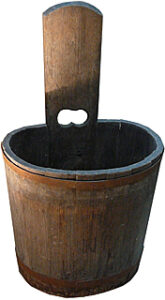
A Büte
As transport was slow, once picked, the grapes were placed in tall, a narrow container known as a mostschafel or „must-maker“ and were bashed with thick poles. This was so that they would take up less space.
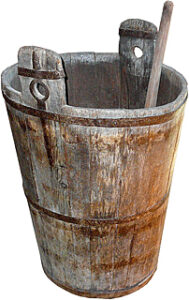
A Mostschafel
Then the battered grapes were then shoveled up into a barrel mounted on a cart known as a Loadfaß. As different yeasts ferment better at different temperatures and soon as the skin of a grape is punctured it starts to ferment, bashing the grapes in a mostschafel is no longer practiced today. Instead modern wine-growers try to transport the grapes as gently as possible only initiating fermentation in the controlled conditions of a cellar.
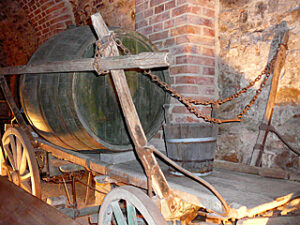
A Loadfaß
In the cart, the grapes were carried down to a central collecting yard where they given a second, more thorough pressing. For hundreds of years, grapes were trod underfoot by two men in a vat, who holding onto each other’s elbows, struggled to remain upright in the squirming mush that wine-growers call “must”. In deep vats and pits, those doing the treading suffered from the invisibly rising carbon dioxide and records from the Middle Ages indicate that people did suffocate whilst treading. Later, shallower vats were used and youths dressed in white shirts and with colored silk ribbons flowing from their hats would hold onto the sides of the vat and stamping in rhythm, would call out:
Stamp out, stamp out!
A good must’ll come about.
Pour in, drink up, yuchoo!
Wine presses with huge beams and wooden cages in which the grapes were pressed by the gradual releasing of the beam’s weight are not mentioned until the fourteenth century. The oldest surviving example of such a press is in Engabrunn in Kamptal not far from Krems and dates from 1564. In Krems, although the rooms on the western side of the cloister of the former Dominican Monastery have not been investigated archaeologically, it may well be that the in-coming grapes were pressed in the room where today, a press dating from 1826 may be seen.
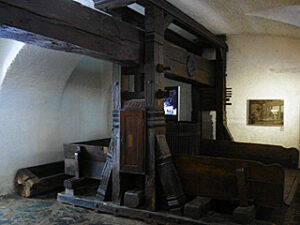
The large wine press in Museum Krems
From the press, the resulting must flowed into a mostgrand from which it was then shoveled up into barrels where fermentation continued. In the press room at Museum Krems, next to the press there is a mostgrand from the Janaburg in Mautern which dates from 1575.
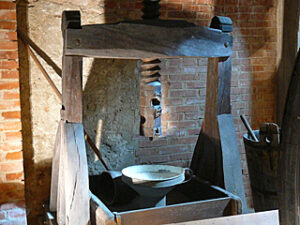
A small wine press
For some two hundred years, the wine made in the Dominican Monastery in Krems will have been aged in barrels on the ground floor, in the rooms on the western and norther sides of the cloister. Yet with the onset of the Little Ice Age that set in towards the end of the Renaissance, yields slumped and grapes often failed to attain the required degree of sweetness. In an attempt to reduce the dry and bitter tastes that resulted, wine was kept for longer. Thus although less wine was produced during The Little Ice Age, the cellars in Krems and Stein were enlarged to such an extent that there is not a single cellar from the Medieval Ages that was not enlarged. In the case of the Dominican Monastery which had been built without cellars, the crisis prompted the building of a cellar system which over the following two hundred years was progressively enlarged. Despite these measures, it must be assumed that the quality of the wine produced was inferior to that produced during the Middle Ages.
As the rotten remains of sediments are what give bad wines their „off“, unpleasant tastes, after it has finished fermenting, wine is „racked“ and pumped into new barrels so that sediments are left behind. To ensure that all sediment has been removed, wines are racked a number of times, with repeated racking and meticulous hygiene being essential to good wine-making.
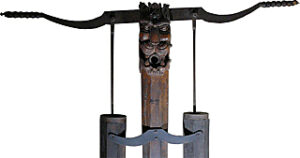
A copy of a Baroque wine-pump
Then as now, during the aging process samples are taken to see how the wine was progressing.
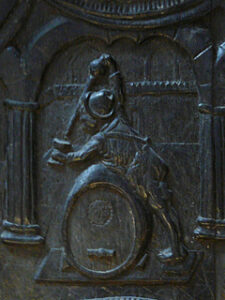
A relief carved on the end of a barrel showing a wine sample being taken from a barrel with a pipette
As it was not until the nineteenth century that fermentation was understood to be the result on invisible bacteria, the process was seen as being watched over by saints who could be called upon to intervene. The patron saints of wine-growing are Saint Urban and Saint Martin. In Lower Austria, wine-growers would also invoke Saint Paul and the Virgin Mary. As Bishop of Langres, Saint Urban is credited with bringing the cultivation of the vine to his diocese before dying a martyr’s death in 230. Sometime before this however, he is said to have evaded persecution by hiding under the leaves of a vine. Compelled to hide for several weeks, the foliage not only concealed him but also gave him sustenance. Meanwhile Saint Martin was evidently an imposing personage as when he was invited to dine with the Roman emperor, Maximus, he was accorded the honour of being allowed to take the first sip of wine. Out of this arose the belief that it was Saint Martin who oversaw the wine’s transition from a cloudy and unstable must, to a clear wine that could be kept. In Museum Krems, the carved end of a barrel shows Saint Urban in his bishop’s robes and tiara together with Saint Martin who is mounted on horseback and bears a sword.
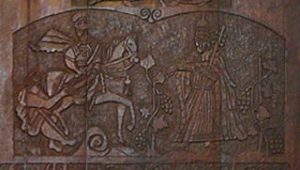
A relief carved on the end of a barrel showing a wine-grower invoking the help of Saint Martin and Saint Urban
Below, there is a supplicant wine-grower and the vines of his vineyard whilst above there is God the Father, God the Son and God the Holy Ghost. Below an inscription reads:
Saint Urban and Saint Martin, prayed to the Holy Trinity that the must and wine would soon come.
The so-called „fig-sign“, that wards off the evil eye was also seen as preventing the wine from going bad and in wine-growing areas is a frequent motif in folk art.
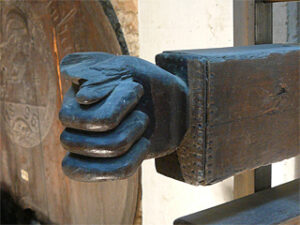
A fig-sign carved on the end of a wedge used in a wine press
Once identified, in cellars, the best wine was traditionally guarded by an effigy of a black cat.
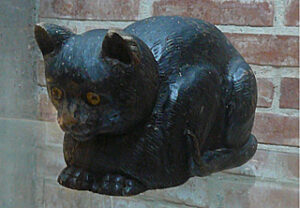
A black cat
In Austria, the still fermenting wine is known as sturm. Murky, cloudy and sweet it can be sampled in vineyard taverns in October. After ten days the yeast settles and the staubige wine is tasted. Pumped out into fresh barrels, the wine then becomes Jungwein. From this moment on, the barrels must be kept full so as to prevent oxygen from entering and spoiling the wine.
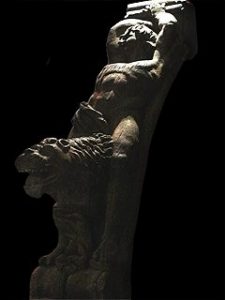
The figure of a youth personifying the new wine
The 11th November is Saint Martin’s Day and it is on this day that the new wine was officially presented and christened. It was also on Saint Martin’s day that the closed-off wine gardens were re-opened.
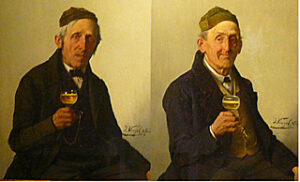
The Sweet and the Sour Wine, by Josef Kinzel
During the Renaissance, wine-growers continued to see themselves as involved in the divine mysteries of Christ’s passion as exemplified by the wine-makers’ guild of Krems-Stein. This guild is first mentioned in a document that dates to 1447 and the Kremser Hauerinnung the oldest wine-makers’ guild in Europe. Enclosed by a wreath of foliage that includes grapes and pears, the Guild’s Arms consist of the letters IHS which stands for in hic sallus or “in this sign”, together with a bunch of grapes that hang as an appendage below.
The insignia of the Krems and Stein Wine-Growers‘ Guild, 1739
Above and below the letters, a heart and a cross suggest that the guild did see itself as having a definite place within the divine plan for the redemption of sin through the celebration of the Holy Eucharist. Hundreds of years later, this was also the line of argument taken by the guild during the Nineteenth Century, when the medieval system of local guilds was centralised and subsumed into trade chambers that were sub-departments of a governmental ministry.
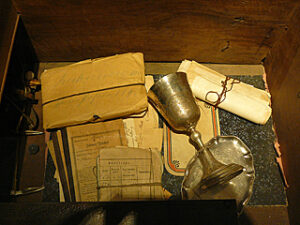
The Holy Communion Chalice and administrate parphanelia of the Wine-Growers‘ Guild of Krems and Stein
To this effect all the guilds in Austria were dissolved except for the Wine-Growers’ Guild in Krems which argued that it was not a trade organization but a religious society. Substantiated by the Guild’s statues, these arguments were accepted by the authorities, so that of all the hundreds of guilds that once were, only the Wine-Growers’ Guild still exists today.
Leaving Krems and going up river to Dürnstein, if you look from the town’s eastern gateway to the north-east, a yellow and white building stands out clearly among the vines. This was built by the Provost of Dürnstein Abbey, Hiernonymous Übelbacher, as a Lustschlossl, or „palace for the appetites“.
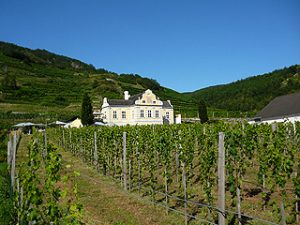
Today the building belongs to the Domane Wachau, which is a wine-growers‘ co-operative. Whilst the grapes are pressed in a modern building left of the Lustschlossel, the wine is aged in the cellars below. These were also built by Übelbacher with a view to raising the quality of the wine wine made at Dürnstein and increasing effiency through centralised pressing and storage. Tours of the cellars begin in the Lustschlössl and end with a tasting during which a selection of wines made by the cooperative may be tasted.
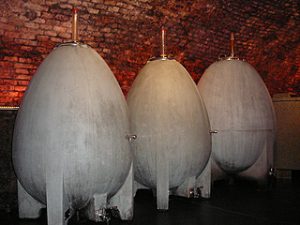
At the Domäne Wachau, the cellar master Heinz Frischengruber, likes experimenting and has wines aging in vats made of concrete as well as vats carved from granite. You can also taste and compare wines made from the same grapes but grown in different places in the valley. This gives you a unique chance to compare the tastes of the different terroirs. Inside the Lustschlossl mottos proclaim, Wine is everything and even more confidently, Wine is over and above everything. To understand what Übelbacher meant by this click on the toggle-title below:
Noah, the Invention of Wine, Wine is Everything
The mottos, Wine is everything and even more confidently, Wine is over and above everything, refer to two things. On the one hand, they refer to the role of wine in the Christian Sacraments. On the other, they refer to Übelbacher’s joie de vivre. Well-earned and in their right place, the joys of man do contribute to the joy of God. Seeing life as nothing but a test that decides whether one goes to Heaven or to Hell, belies the beauty and complexity of God’s creation. It is thus our duty to graciously accept the joys of life and give thanks for them, by appreciating them. The relevance of this is that it was in the Lustschlossl that Übelbacher entertained his friends. Reading between the lines of his diaries, it is clear that on occasion, they lived it up.
In The Bible, wine has a distinguished pedigree that begins when after the Flood, Noah became a man of the soil and planted a vineyard. Picking some grapes and gathering them together in a pot, the Patriarch was then distracted and when he came back, brew was already fermenting. Undaunted, Noah drank the brew and then, as The Bible says, overindulged. Becoming inebriated he fell asleep and was found later by his sons, lying naked on the ground. Discretely covering their father’s indecency over with a sheet, they then left him to his slumbers. In The Bible, the story jumps from the planting out of the first vineyard to the first over-indulgence, with no explanation being given of how Noah knew that grapes were edible. Regional tradition filling in where the holy texts fall silent, in Lower Austria it is said that it was a nibbling goat that gave Noah the idea of planting out a vineyard with a view to eating the fruit.
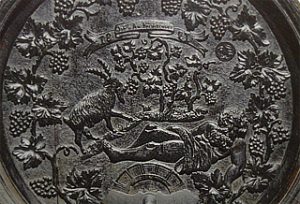
Noah and the goat, detail from a relief carved on the end of a barrel, 1881, Museum Krems
Following in Noah’s footsteps, wine-growers clearly played a part in the Christian story. Yet as lay people, they knew it was not their place to claim too much of a central role. Accordingly they associated themselves with Noah and in Lower Austrian folk art, Noah is often shown together with a goat. In this way, the wine-growers were able to present themselves as being close to the central mystery of Christianity without making any undue claims.
image coming soon
Later on in the Book of Genesis, Abram helps a number of kings defeat an alliance of other kings. As he returns, he is met by the Kings of Salem and Sodom. Melchizedek, the King of Salem, is also a High Priest. Bringing bread and wine to Abram, he blesses him. This is the first mention in The Bible of wine in a sacred context. Melchizedek’s blessing paves the way for the covenant made by God with Abram who thereupon becomes Abraham. In the Old Testament another reference to grapes occurs in Numbers, 13:23. Arriving in the Promised Land, God instructs Moses to send out scouts. As a proof of the land’s bounty, the scouts return with a bunch of grapes. The bunch is so huge that it is hung over a pole and carried on the shoulders of two men.
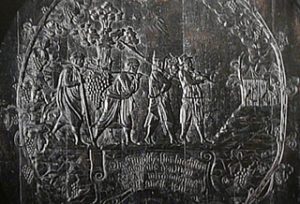
The scouts of Israel returning with grapes, detail from a relief carved on the end of a 1,890 Litre barrel, Museum Krems
As shown carved on the end of a barrel in Museum Krems, a text accompanies the scene. This hints at the problems encountered by Noah when he first sampled wine. Translated, it reads:
The scouts have brought
the wine home
and for sure the monkey
won’t be far away.
This is a reference to a Jewish interpolation to the story of Noah. In the Midrasch Tanhuma, the Devil sees Noah planting up his vineyard. Going over to him, he asks what he is doing. Noah replies that he is planting out vines on which a sweet fruit will grow. Hearing this, the Devil suggests that they enter into a partnership. For his part, the Devil promises to make a sacrifice that will double the yield. Once harvested they can then divide the grapes equally between them. To this, Noah agrees and the Devil duly sacrifices a sheep, a lion, a pig and a monkey. These he buries in the soil that Noah has planted up. The Devil then says that the juice of the fruit will make whoever drinks of it mild like a sheep. If more is drunk, the person will acquire the courage of a lion. Yet continued, over-indulgence will make them behave objectionably like a pig. Thereafter, whoever continues to over-indulge, will end up behaving like a monkey.
Despite these warnings, with doctorates in philosophy and theology, Übelbacher was more than capable of proving the truth of what was written on the walls of his Lustschlössel and in a tabernacle he designed for the Abbey Church, he had this truth cast in bronze. Divided like a globe into fourty-four sections, the tabernacle shows scenes from the life and afterlife of Christ. One scene is that described by John in 13:1-30. In a act of humility that was normally reserved for the lowest servant, during the Last Supper, Jesus poured water into a basin and washed the feet of his disciples. Puzzled as to why their Lord and Master should, in the middle of a meal, suddenly wash their feet, Jesus said that in due course they would come to understand. He also said that although, they were clean and only their feet needed washing, one of them would betray him. Jesus then intimated to them that he was going to a place where they could not go but to which they would come to in due course. Tellingly enough
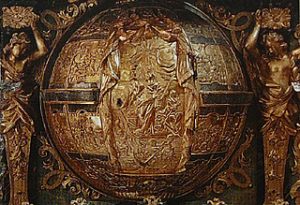
The washing of the disciple’s feet demonstrates the overwhelming and cleansing power of forgiveness and draws much of its meaning from an earlier incident described by Luke in 7:36-50. This episode was later painted on the ceiling of the festive suite at Dürnstein Abbey.
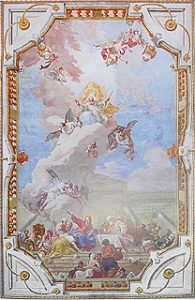 Painted by Martin Johann Schmidt (also known as Kremser Schmidt), the painting shows Jesus at the house of Simon the Pharasee. Invited to dine at Simon’s house, after he had taken his seat, Jesus haf been approached by a woman who, as she weeped and cried, washed his feet with the water of her tears and dried them with her hair. Kissing his feet, she then annonted them with oil. Seeing the woman was a prostitute, the Pharasees had begun to talk among themselves, saying that if Jesus were really a prophet, she would not have her touch him. At this, Jesus had turned to Simon and pointed out that when he arrived, no one had kissed him and no one had provided water for his feet. He then asked, given two debtors, one of whom owed his creditor a lot of money, whilst the other only owed a small amount, if the creditor were to cancel both debts, which of the two debtors would be more grateful. To this Simon had answered that the one who had owed a lot would be more greatful. „You have answered correctly,“ Jesus replied and had then declared the woman’s sins forgiven. When the Pharasees began to mumble among themselves saying, „Who is this who declares such sins forgiven?“ Jesus had ignored them and simply said to the woman, „Go in peace, your faith has saved you.“
In the festive suite at Dürnstein, important guests were entertained and so by virtue of Baroque illusionism, Jesus was also present, reminding those assembled that petty differences should never in stand in the way of those gathered together in faith, and that the best reason for any celebration, is that God so loved the world that he sent his only son to die, that mankind might be saved from the iniquity of sin. Thus to the believer who drinks wine, Christ offers joy and forgiveness, whilst for non-believers, the Devil holds up a mirror that peers ever more deeply into the murky depths of the human soul. Accordingly for both believers and non-believers alike, there is truth in wine and in many senses, wine really is everything.
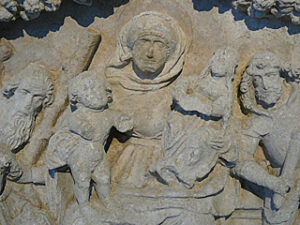
Here I am again in Museum Krems, and here’s a relief that shows Amalthea munching her way through Noah’s vineyard whilst the Patriarch sleeps off the first recorded hangover!
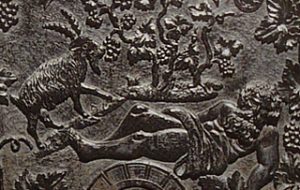
Apart from the confusing tract, Death and Resurrection, which you may have read above, Amalthea also gave me a book by some young upstart but again I can’t make head nor tail of it. Its written by someone who can’t even decide what to call himself, Bacchus, Dionysus, Liber, Osiris and goodness knows what. Not can he decide whether he’s an infant, a youth or a man with a beard. Anyway here he is as a juvenile with Amalthea, who was his wet-nurse after his mother got incinerated in some kind of accident. Amalthea says that it was he who invented wine and not Noah and she ought to know because she was around back then. Anyway the rascal has a bunch of grapes in his hand and is looking ridiculously pleased with himself.
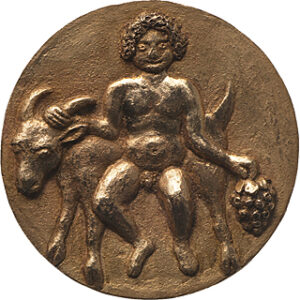
If only someone could take that smile off his face! I made a petition to Him on High but the answer came back that the grapes and the smile are all part of the way of things. If Heaven can’t help us who will? Well Jesus of course – when he rises again! Which raises the question of why did they have to kill him in the first place? I’m a saint from the New Testament but my heart’s in the Old and I have difficulty in understanding the new fangled ways of the new message. Life through death? If people behaved properly in the first place, there would be no sins to forgive and no need for Jesus to die. But then again, maybe you see things differently!“
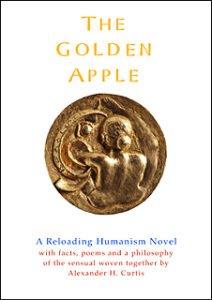
The Golden Apple
Coming soon: a work of literary fiction by Alexander H. Curtis of 62,000 words
„You must go back to the beginning…“ With these words, Dionysus, God of Wine and Altered States, is charged with a mission to save, not only the standing of the gods of old but also the world of the present. Not told what he is to do or what it might be that he is to look for (for not even Zeus himself knows), he is simply given a message to deliver to his uncle. Intrepidly journeying down into the underworld, Dionysus is inexorably drawn back to a time when the world was young. Finding the Golden Apple that started the Trojan War, he stumbles through history in an ad hoc manner, reawakening the lost and scattered facets of his own self. Unwittingly becoming an initiate of his own rites he begins an affair with a courtesan. This leads to an unexpected re-awakening of his procreative powers and brings his long-forgotten consort, Ariadne to mind. Thus summoned, his consort appears, all be it in an unexpected form. Instructed in philosophy by a cicada, the once again young god comes to understand the unique source of his power and why it is that he must repeatedly return to the underworld. With the help of some mortals who have eaten ambrosia, he succeeds in outwitting his uncle and as he leaves Hell behind him for the last time, he realises that though his adventures, he has solved the riddle that the fates had assigned him. Reappearing in Rome at the end of the eighteenth century, he re-awards the Golden Apple and journeying on to Vienna, initiates a process in which the world is born anew. Unexpectedly transposed to Edinburgh, he finds himself face to face with Ariadne who in human form is a freckle-faced philosophy student with red-hair. When Zeus appears, Dionysus introduces her as his bride to be. Post haste, a wedding is arranged and Dion as he now calls himself, finds that once again he is about to become the center of attention. Moreover, he knows that following his wedding, it will be up to him to do what Zeus and the other gods cannot.